Sign in. It’s quick, free and it’s up to you.
An account is an optional way to support the work we do. Find out more.
Sign in. It’s quick, free and it’s up to you.
An account is an optional way to support the work we do. Find out more.
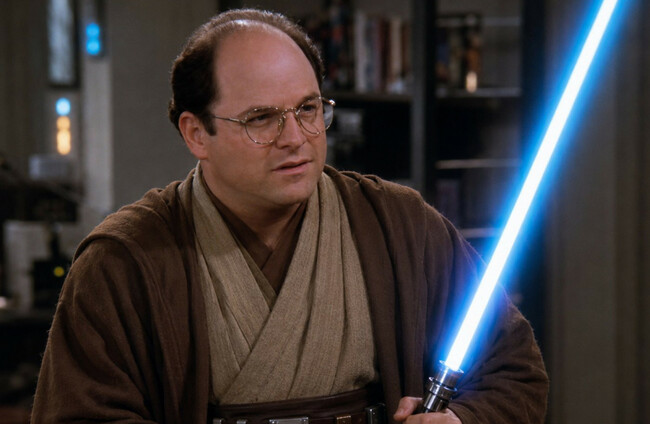
THE SUMMER OF George is back.
Seinfeld’s most aggrieved and unbeautiful protagonist became a meme this week after stills from the show were put through AI image editing tools to reimagine him in different styles and outfits.
The trend began when one user on X edited a still of George Costanza, played by Jason Alexander, using image generators to give him a modern “bald plus beard” look.
Soon he became a protean figure, re-shaped into whatever reference people wanted to deploy for amusement.
There was George as The Thing from Fantastic Four, George as the eponymous character from the Duke Nukem video game series, George as Obi Wan Kenobi, and George and other characters from the show dressed in cyberpunk outfits.
The result was a simulacrum of Seinfeld: familiar enough to be recognisable, yet hollow enough that it wasn’t as funny as the real thing.
It did what memes usually do, with an army of social media users taking the initial gag and recycling it with different cultural references in increasingly absurd ways.
Within a day, the images were everywhere in my feed and someone even went as far as creating extremely weird, deepfaked scenes in which Jerry and George have a conversation about peptide-inspired self-improvement.
It felt like a new moment in meme culture, where two inevitable parts of the AI revolution came together.
The first was that generative AI tools have become so ubiquitous that almost anyone can now create a realistic image of a sitcom character in a ludicrous outfit or scene.
The Seinfeld trend arguably would not have spread like this a year ago, when far fewer people would have known how to get in on the joke.
That has brought us to a second point, where slop is starting to look much less sloppy than it used to, which in turn allows it to gain currency in online spaces.
It was one of the odder aspects about the George Costanza memes: they were clearly throwaway jokes, but for the most part, they no longer looked like the uncanny figures that I’ve come to expect in AI images.
Older memes often worked by reconfiguring existing moments through captions, screenshots and mashups; AI has brought us a different type of meme that allows cultural artefacts to be reimagined.
A show like Seinfeld is ideal for this because it is old enough to carry nostalgic weight but familiar enough that even casual fans recognise its characters, humour and visual language.
But the process isn’t just limited to old sitcoms.
In an even stranger example this week, AI was used to superimpose Donald Trump over Owen Mulligan in a clip of the former Tyrone footballer’s iconic goal against Dublin in Croke Park in 2005.
The remixed clip – a reference to Trump getting USA striker Folarin Balogun’s World Cup suspension lifted - was a strange mash-up of GAA nostalgia, AI absurdism, and Fifa politics.
It’s not to say that people didn’t do this before; image editing software like Photoshop and face-swapping apps made remixing like this possible long before generative AI tools went mainstream.
The difference is that AI has made the whole endeavour frictionless and less time-consuming.
The worry is that this nudges people away from creating new things and towards endlessly rearranging old ones.
I admittedly found a lot of the memes funny, which is partly why the whole thing felt a little uncomfortable once I started thinking about it.
It’s an example of what the late British cultural theorist Mark Fisher described as “the slow cancellation of the future”, a sense that modern culture has become trapped in loops of revival and retro-fixation.
What is supposedly new is actually arriving as a slightly modified version of things we already recognise, which dulls our creativity and our imaginations.
Artificial intelligence did not create this condition; the internet had already spent years conditioning us to understand culture as a set of references to be reconfigured, re-captioned and recontextualised.
But AI is the perfect tool for a culture that has become stuck in this cycle.
It allows people to produce infinite variations of familiar things within minutes, and lets us feel momentarily like we’re looking at something new.
These kinds of creations may be more aesthetically pleasing than the AI slop we’ve become used to in recent years, but they’re still disposable by design.
The images are amusing for the few seconds it takes to register the joke, maybe longer if they are particularly funny, before disappearing into the endless churn of social media.
They are also normalising the use of AI for creative purposes at a time when generative tools are posing a huge threat to creative industries.
Part of the problem is that the internet trains us to experience these things as quick and harmless, in part because they’re forgotten so quickly.
This all happened in the same week Ireland was reminded that the supposedly weightless internet is anything but, with CSO figures showing that data centres accounted for 23% of the country’s metered electricity consumption last year.
Of course, it would be absurd to say that one George Costanza meme is melting the grid. But the mass normalisation of casual AI generation is not without consequence.
The jokes disappear almost as soon as they arrive. The effects of the infrastructure that makes them possible lasts a lot longer.

To embed this post, copy the code below on your site















have your say